

Sophia
July 19, 2026 · 13 min read
AI Real Estate Photo Editing:
How AI Improves Listing Photos
To edit real estate photos well, you fix five things in order: exposure and white balance, vertical lines, distractions, exteriors (sky, lawn, twilight), and a final check that nothing misrepresents the home. You can do that in Photoshop or Lightroom, or you can AI edit real estate photos in a browser tool in a few minutes per listing. This guide covers the step-by-step workflow, how to edit HDR real estate photos, how Photoshop, Lightroom, and AI photo editing websites compare, and how to use the edited photos for real estate listing promotion.
For buyers, listing photos are often the first filter. Before they read the property description, they scan the images and decide whether the home feels worth a closer look. That makes photo quality a conversion issue, not just a design issue.
VideoGuru supports this workflow by helping agents edit still photos, identify enhanced images, and continue those edited photos into a photo-to-video listing workflow. Virtual staging can be part of the broader product, but this guide focuses on the practical AI edits that improve listing photos before they become listing pages, social posts, emails, or videos.
Key Takeaways
- AI can improve listing photos automatically when the request is specific and realistic: declutter, sky replacement, lawn polish, twilight mood, fireplace warmth, or a focused custom edit.
- The best AI real estate photo editing tool should improve photos without making the listing feel fake.
- VideoGuru connects photo editing with the next marketing step: using edited photos in a property video workflow.
- Virtual staging is useful, but this article keeps the main focus on improving existing listing photos.
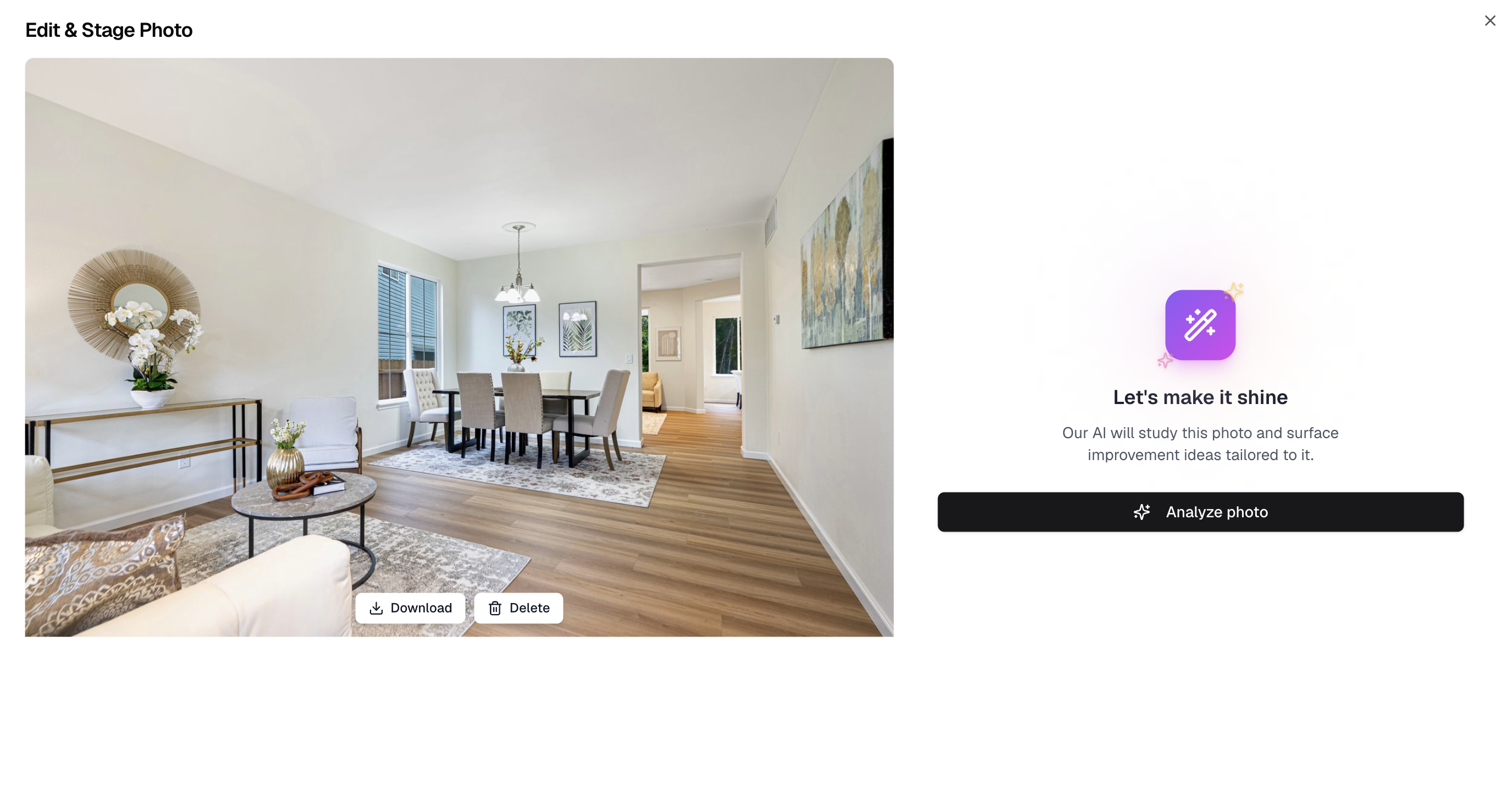
VideoGuru's photo editing entry window helps agents choose practical edits for listing photos.
What Is AI Real Estate Photo Editing?
AI real estate photo editing is the use of artificial intelligence to improve property listing images. It can help agents clean up distractions, improve exterior presentation, add warmth, and make focused corrections while keeping the photo realistic and listing-ready.
A good workflow does not ask the agent to become a Photoshop expert. It starts from the way agents think: this room needs less clutter, this exterior needs better curb appeal, this photo needs a warmer mood, or this one visible issue needs a custom correction.
- Declutter: remove or reduce small distractions so buyers focus on the space.
- Sky replacement: make exterior photos feel brighter and more inviting.
- Lawn enhancement: improve curb appeal when grass or landscaping needs polish.
- Virtual twilight: turn a daytime exterior into a warmer evening-style image.
- Custom edit: describe a specific correction that does not fit a preset.
Can AI Improve Listing Photos Automatically?
Yes. AI can improve listing photos automatically when the source image is already useful and the desired edit is clear. The best results come from realistic requests that enhance the original photo rather than inventing a misleading version of the property.
| Listing photo problem | AI edit | Buyer-facing benefit |
|---|---|---|
| Small distractions pull attention from the room | Declutter or custom cleanup | The room feels more polished and easier to evaluate |
| Exterior sky looks gray or flat | Sky replacement | The listing creates a stronger first impression |
| Yard or landscaping needs polish | Lawn enhancement | Curb appeal looks cleaner without reshooting |
| Daytime exterior lacks mood | Virtual twilight | The property feels warmer and more memorable |
| One visible issue does not fit a preset | Focused custom edit | The agent gets more control while staying realistic |
Why AI Photo Editing Matters for Listing Performance
Listing photos shape the buyer's first impression. Strong photos help buyers understand layout, lighting, condition, atmosphere, and the property's best features. Weak photos create doubt, even when the home itself is strong.
AI does not replace professional judgment, but it can remove friction from common editing work. For agents and small teams, that means faster turnaround, more consistent visuals, and more assets that are ready to reuse across MLS pages, social posts, email campaigns, open house promotions, and videos.
AI photo editing is a marketing workflow, not only an image fix
The best reason to ai edit real estate photos is not to create one nice before-and-after example. It is to make the entire listing campaign stronger. A cleaned-up exterior photo can become the listing hero image, the email thumbnail, the first frame of a short video, and the cover for a seller update.
See VideoGuru's photo editing workflowHow to Edit Real Estate Photos: A Step-by-Step Workflow
Most agents who edit their own listing photos do too much in the wrong order. Here is how to edit photos for real estate in a sequence that works whether you use Lightroom, Photoshop, or an AI tool. Budget 3–5 minutes per photo by hand, or under a minute per photo with AI, for a typical 25–35 photo listing.
- Fix exposure and white balance first. Interior shots are usually 1–2 stops under and lean yellow from warm bulbs. Lift shadows, pull highlights back from windows, and set white balance so walls read as their real color. Do not touch anything else until this is right.
- Straighten verticals. Buyers notice leaning walls before they notice anything else. Use the transform or lens-correction tool to make door frames and wall edges vertical. Crop to remove the empty corners this creates.
- Remove distractions. Cords, trash cans, a car in the driveway, a bathroom mat. Removing small items is standard practice. Removing or hiding permanent features (a power line at the property edge, a crack, a neighbor's house) is not — see the AI photo disclosure rules for 2026 before you go further.
- Handle exteriors. Replace a flat gray sky with a realistic blue one, green up a patchy lawn, and consider one virtual twilight for the hero exterior. Keep the sky and shadows consistent — a sunset sky over a noon shadow reads as fake.
- Final pass for consistency. All 25–35 photos should look like the same house on the same day. Match brightness and warmth across the set, then export at MLS size (most MLSs accept 1024–2048 px on the long edge; export a 4000 px master for print and video).
How to edit HDR real estate photos: HDR starts with 3–5 bracketed exposures of the same frame, usually 2 stops apart. Merge them in Lightroom (Photo → Photo Merge → HDR) or Photoshop, then treat the merged file like any other photo: pull the tone-mapping strength down until it looks natural, since over-processed HDR with halos around windows is the most common giveaway of an amateur edit. Many agents skip bracketing now and shoot a single well-exposed frame, then let an AI enhancer balance windows and shadows; our HDR vs AI photo enhancement comparison shows when each approach wins.
How to AI edit real estate photos: upload the photo, pick a preset (declutter, sky replacement, lawn, twilight) or describe a custom fix, review the result, and keep only what looks believable. The workflow is the same five steps above — the tool just does steps 1, 3, and 4 for you. If you are new to this, the AI photo editing guide for agents walks through a first listing end to end.
How VideoGuru Helps Agents Improve Listing Photos
VideoGuru organizes photo editing around the edits real estate agents actually need. The VideoGuru photo editing workflow shows how agents can stage rooms, clean up photos, improve curb appeal, add warmth, make custom edits, and use edited photos in a video workflow.
1. Clean up the photo
Use cleanup edits when the photo already shows the right space but small distractions are pulling attention away from the property. In VideoGuru, declutter-style edits can help reduce visual noise while keeping the image believable.
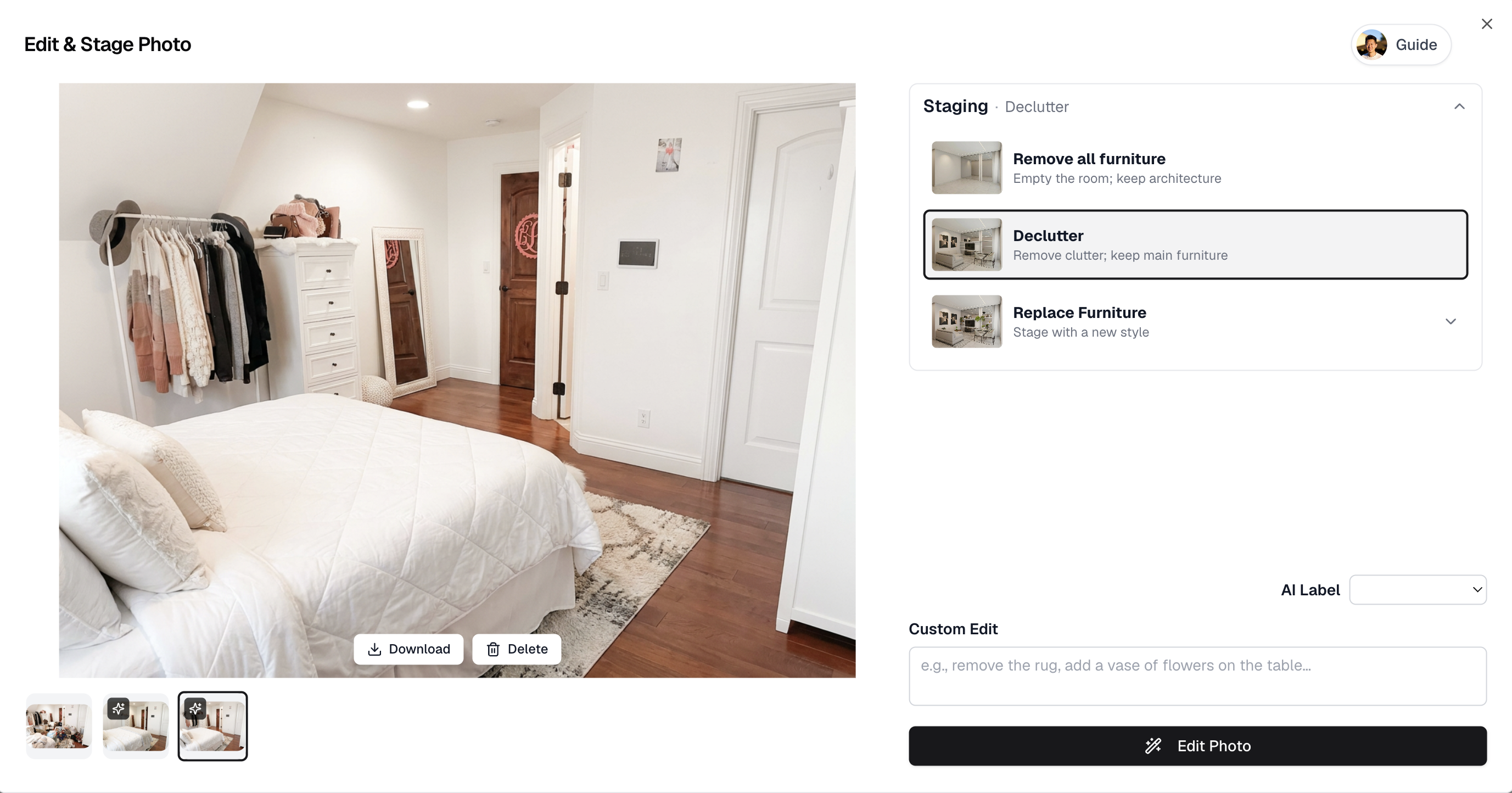
Declutter edits help reduce visual distractions in an otherwise useful listing photo.
2. Improve curb appeal
Exterior photos often decide whether a buyer clicks into the listing. VideoGuru supports curb-appeal edits such as sky replacement and lawn enhancement, which can make a property photo feel brighter and cleaner without requiring another shoot.
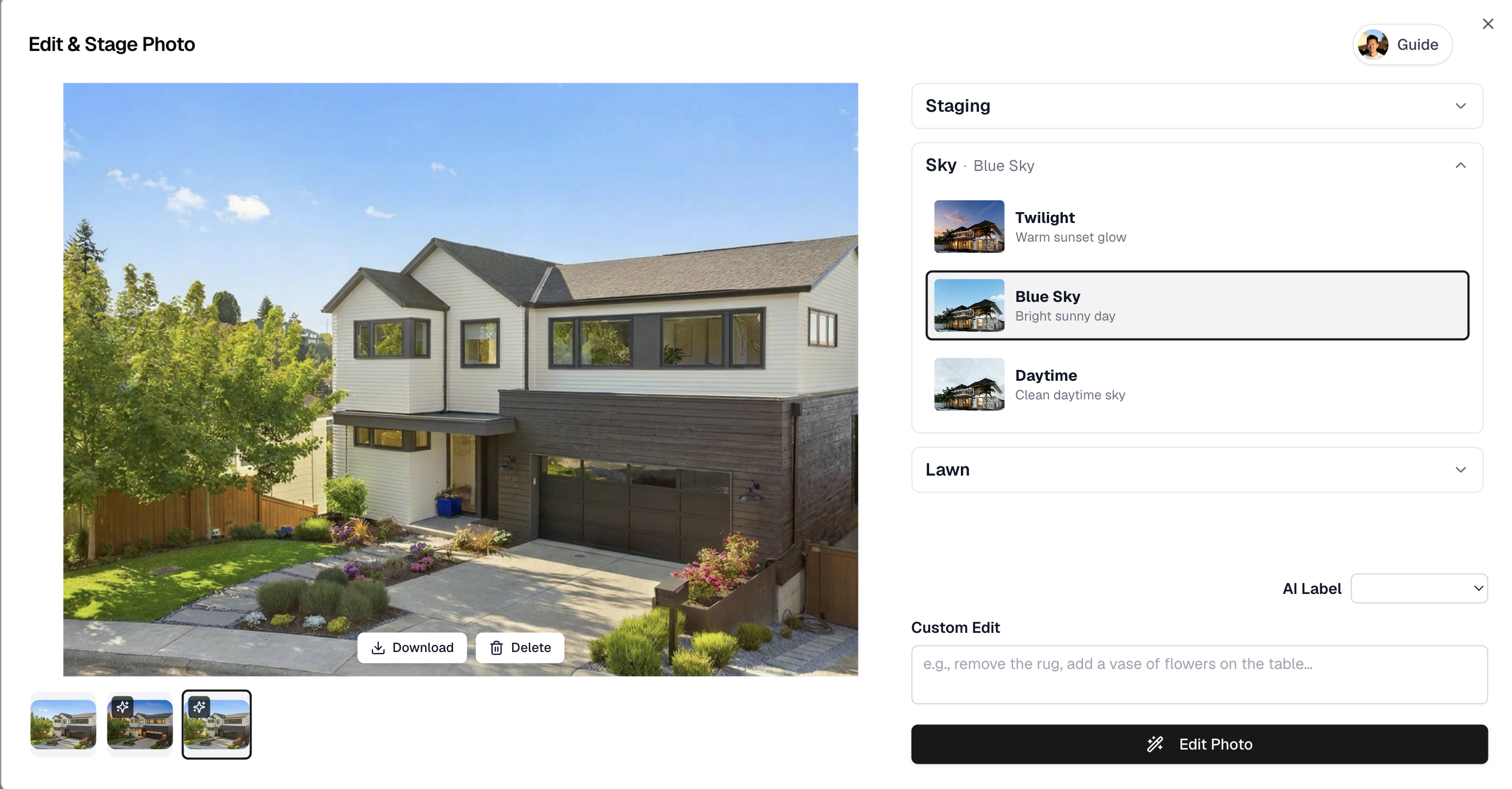
Sky replacement can make exterior listing photos feel brighter and more inviting.
3. Add warmth and atmosphere
Some listing photos need mood more than correction. VideoGuru includes ambience-style edits such as virtual twilight and fireplace enhancement. Virtual staging can be useful for empty rooms, but for this workflow the bigger point is simple: make existing photos feel more inviting while staying listing-ready.
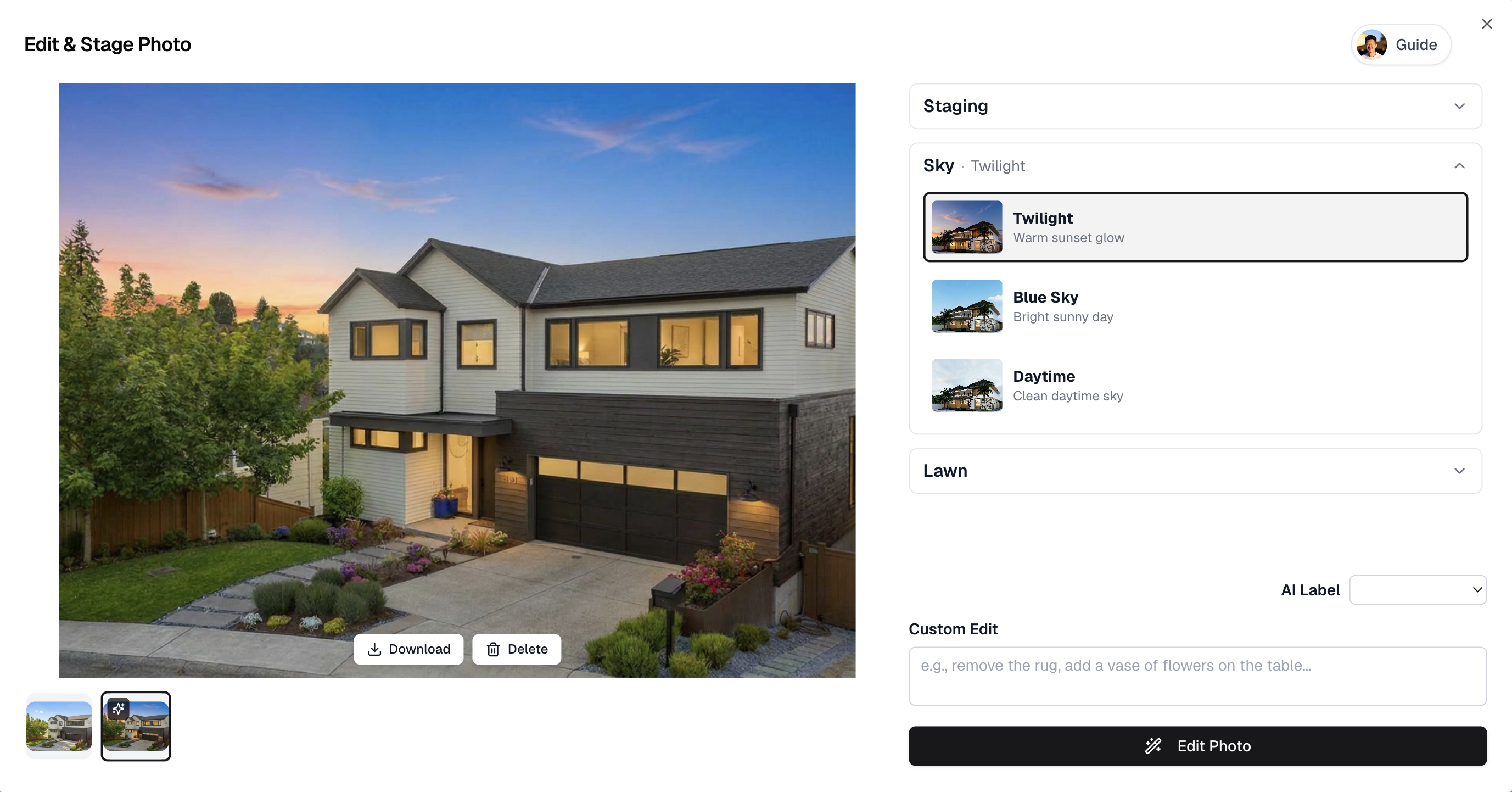
Virtual twilight can give an exterior photo a warmer first impression.
4. Make a focused custom edit
Not every photo issue fits a preset. VideoGuru's Custom Edit option lets the user describe a specific change. The best custom requests are focused, visible, and realistic, such as cleaning up one distraction or improving one part of the image.
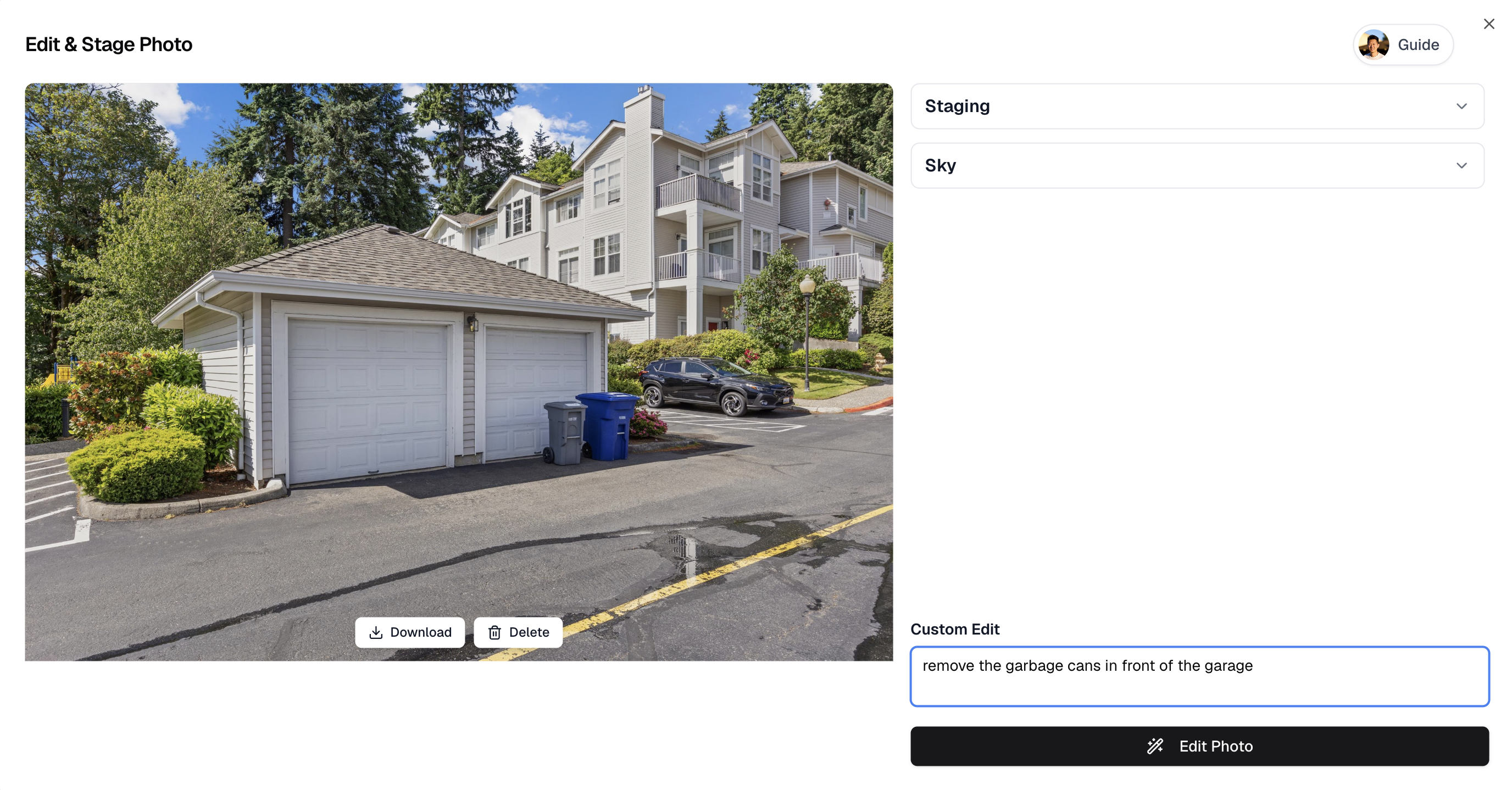
Custom edit gives agents more control when a listing photo needs a specific correction.
Photoshop vs. Lightroom vs. an AI Photo Editing Website: Which Is Best for Listing Photos?
Agents asking about the best software for editing real estate photos usually mean one of three things: editing real estate photos in Lightroom, editing real estate photos in Photoshop, or using a real estate photo editing website that runs in the browser. Each is the right answer for a different agent.
| Option | Best for | Time per listing (30 photos) | Cost | Learning curve |
|---|---|---|---|---|
| Lightroom | Batch color, exposure, verticals, HDR merge across a full set | 45–90 min | About $10–$12/month (Adobe Photography plan) | Moderate: a weekend to get comfortable |
| Photoshop | Object removal, sky replacement, compositing, detailed retouching | 2–4 hours (you edit photo by photo) | Included in the same plan, or about $23/month alone | Steep: layers, masks, and clone tools take weeks |
| AI photo editing website | Agents who want declutter, sky, lawn, twilight, and virtual staging in a click | 10–20 min | Free tiers exist; paid plans typically $20–$60/month or $1–$3 per photo | Low: upload, choose an edit, review |
| Outsourced editor | Photographers and teams shipping 5+ listings a week | 0 min of your time; 12–48 hour turnaround | $0.50–$2 per photo standard; $5–$30 per photo for staging or twilight | None, but you lose same-day control |
Editing real estate photos in Lightroom is the right call if you shoot your own listings and want a repeatable look: build one preset for interiors and one for exteriors, sync it across the set, then fix verticals in the Transform panel. Editing real estate photos in Photoshop only makes sense for the two or three hero shots that need a sky swap, an object removed, or a composite — most agents never need it for the other 25 photos. Both Adobe tools assume you already know what a good listing photo looks like; a full comparison of doing it yourself versus paying someone is in our AI vs human real estate photo editing guide.
A real estate photo editing website is the better fit for agents who are not photographers and do not want to become one. For agents who want a decluttered room, a bluer sky, or a staged photo in one click and then use those photos in a listing video, VideoGuru's photo editing is built for that job; it does not try to replace Lightroom for a photographer running 50 listings a week. Photographers at that volume should look at the batch photo editing workflow instead, where AI handles the first pass and Lightroom handles the final grade.
What Is the Best AI Real Estate Photo Editing Tool?
The best AI real estate photo editing tool is the one that fits the agent's actual listing workflow. A single impressive before-and-after image is not enough. Agents need a repeatable process for improving photos, reviewing the result, and using the edited images in the rest of the campaign.
| Selection criteria | Why it matters | How VideoGuru supports it |
|---|---|---|
| Real estate-specific edit types | Agents need listing outcomes, not generic photo filters | Declutter, curb appeal, twilight, custom edit, and staging options |
| Realistic output | Listing photos must preserve buyer trust | Workflow encourages focused, listing-ready edits |
| Easy next step after editing | Edited photos should support the whole campaign | Edited photos can continue into VideoGuru's photo-to-video workflow |
| Clear asset management | Agents need to know which photos were enhanced | Edited photos are marked with a star in the workflow |
Turn Edited Listing Photos Into Video
One reason VideoGuru stands out is that photo editing does not have to be the end of the workflow. After the edits are complete, agents can use enhanced photos in the photo-to-video workflow. This matters because the same improved image can become a listing page asset, a social thumbnail, and a clip inside a property video.
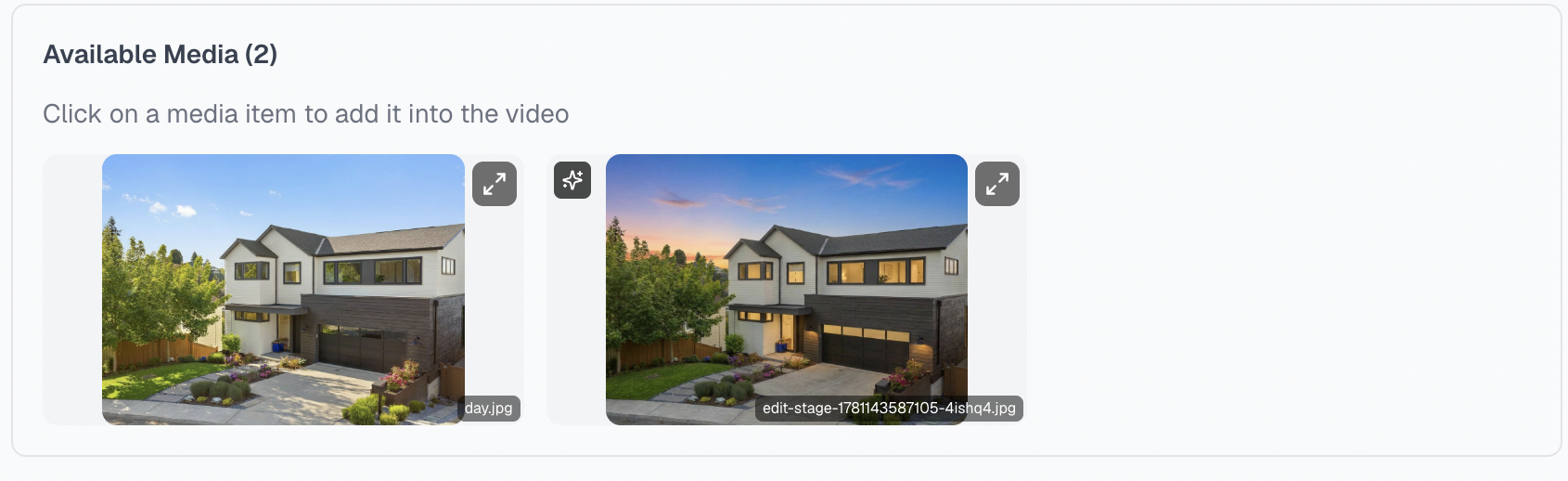
Edited photos are marked with a star so agents can identify enhanced assets when creating a video.
A simple workflow for agents
- Choose the listing photos that already show the property clearly.
- Use VideoGuru photo editing to clean up distractions, improve curb appeal, or add atmosphere.
- Review the edited photos and keep only realistic, listing-ready results.
- Use those edited photos in a property video, social post, email, or listing page.
Using Edited Photos for Real Estate Listing Promotion
Editing is only half the job. Real estate listing promotion is where the edited photos earn their keep, and the same 30 images should feed at least five channels. Plan the edits with those channels in mind: the hero exterior becomes the MLS cover, the social thumbnail, and the first frame of the listing video, so it deserves the twilight or sky edit before anything else does.
- MLS and portals: upload the full set in the order a buyer would walk the home. Listings with 20+ professional-quality photos get noticeably more views than listings with fewer than 10, and the first photo does most of the work.
- Social: post 3–5 edited photos as a carousel on launch day, then a 15–30 second photo-to-video reel. Vertical crops (9:16) of the best interiors perform better than the landscape MLS versions.
- Email and print: two or three hero photos in the just-listed email and on the flyer. Use the 4000 px master here, not the MLS-size export.
- Listing video: edited photos become a 30–60 second walkthrough with music and a call to action in about 10 minutes using an AI photo-to-video tool.
The efficient move is to edit once and reuse everywhere. Our guide on how to repurpose listing content across channels shows a one-shoot, five-channel schedule that most agents can run in an afternoon, and the listing photo mistakes that cost conversions post covers the errors that undo good editing at the promotion stage.
When to Use AI Real Estate Photo Editing
Use AI real estate photo editing when the original photo is useful but needs a specific improvement. AI works best as a polish layer, not as a replacement for accurate property representation.
- Use it when a photo needs cleanup, not a complete invention.
- Use it when speed matters and the listing cannot wait for a full editing cycle.
- Use it when one shoot needs to feed multiple channels: MLS, social, email, website, and video.
- Use it when you need consistent listing visuals across a full campaign.
Do not over-edit. The goal is to make the listing easier to understand and more appealing, while keeping the result believable for buyers who will eventually see the home in person.
FAQ
What is AI real estate photo editing?
AI real estate photo editing uses artificial intelligence to improve listing photos through practical edits such as decluttering, sky replacement, lawn enhancement, virtual twilight, fireplace enhancement, and custom corrections.
Can AI improve listing photos automatically?
Yes. AI can improve listing photos automatically when the requested edit is specific and realistic. It can clean up distractions, improve curb appeal, add warmth, or make a focused correction while keeping the image listing-ready.
What is the best AI real estate photo editing tool?
The best AI real estate photo editing tool is one that improves photos realistically and fits the full listing workflow. VideoGuru is a strong option when agents want to improve still photos and then reuse those edited photos in property videos.
How should agents ai edit real estate photos without making them look fake?
Agents should ai edit real estate photos by focusing on believable improvements: remove small distractions, improve exterior presentation, adjust mood, and make custom edits that match the visible photo. Avoid edits that misrepresent the property's layout, condition, or permanent features.
How do you edit HDR real estate photos without them looking fake?
Shoot 3–5 bracketed exposures about 2 stops apart, merge them in Lightroom or Photoshop, then reduce the HDR strength until windows show a natural view without a halo around the frame. Keep interior warmth realistic and match all photos in the set so no single image looks over-processed. If you only have one exposure, an AI enhancer can balance windows and shadows in a single pass and often produces a cleaner result than a heavy HDR merge.
Do you need Photoshop or Lightroom to edit real estate photos?
No. Lightroom is the better choice if you shoot your own listings and want batch control over a full set, and Photoshop is only needed for a few hero shots that require object removal or a sky swap. Most agents editing their own listing photos get a listing-ready result from an AI photo editing website in 10–20 minutes for 30 photos, with no software to learn.
Final Takeaway
AI real estate photo editing is valuable because it makes listing visuals faster to improve and easier to reuse. The practical wins are simple: cleaner photos, stronger curb appeal, warmer atmosphere, and better assets for the rest of the listing campaign.
VideoGuru brings those pieces together by helping agents improve still images and continue into video creation from the same listing assets.
Improve listing photos, then turn them into videos
Use VideoGuru to edit real estate photos, identify enhanced images, and continue into a photo-to-video listing workflow.