
Chengran (Felix) Guan
2026-08-09 · 11 min read
Case Study:
How Drone Video Added 30% More Listings for This Photographer
Adding drone video to a real estate photography business is one of the fastest ways to win more listings. In this case study, a solo photographer in a mid-sized market grew his listing count by 30% in 18 months by adding aerial video to his service menu — without buying a second camera, hiring staff, or doubling his editing time. Here is the exact service menu, pricing model, marketing playbook, and delivery workflow he used.
Key Takeaways
- Aerial video is a differentiator, not a commodity: fewer than 1 in 10 photographers in his market offered drone video, so it won him bids against photo-only competitors.
- Packaging beats per-service pricing: he moved from a $175 standalone aerial package to tiered photo + video bundles, and average order value rose 42%.
- Compliance is a selling point: FAA Part 107 certification let him pitch liability-safety to brokerages that had been burned by unlicensed drone operators.
- AI editing keeps aerial turnaround at 48 hours: automated editing absorbed the extra footage without adding editing hours.
- The 30% came from referrals, not ads: agents who received aerial video re-booked at 3x the rate of photo-only clients.
What Percentage of Real Estate Listings Have Video? The View Statistics
The percentage of real estate listings with video is still low enough to be a real edge. Across the major portals, fewer than 3 in 10 listings carry any video walkthrough, and only about 1 in 4 agents say they add video to every listing they take — even though 73% of sellers tell the National Association of Realtors they are more likely to list with an agent who uses video. The gap between what buyers expect and what most listings deliver is the opportunity.
The view statistics for real estate listings with video are what close the argument. Listings with video are widely reported to receive roughly 4x more inquiries than photo-only listings — the often-cited 403% figure — and homes marketed with video sell for up to 6% more. Properties with a video walkthrough or virtual tour draw roughly 87% more views, and about half of buyers say watching a video made them more likely to book a showing. These are directional numbers, not guarantees, but the direction has held steady for years. For the metrics that matter after the video ships, see our real estate video analytics guide.
The benefits of video walkthroughs in listings go beyond the raw numbers. A walkthrough pre-qualifies buyers before they spend a showing, shows room flow and light that stills cannot, and gives the seller visible proof you market harder than the photo-only agent down the street. For photographers and agents alike, every one of those benefits is a line item you can charge for.
Why Drone Video Wins Listings in 2026
Aerial footage shows what ground-level media cannot: lot size, neighborhood context, proximity to schools and transit, and the roofline condition that drives buyer questions. Real estate portals have made aerial media a standard expectation — Zillow's agent guide to drone photography recommends aerial shots for properties on large lots, near amenities, or with architectural details best seen from above.
The market data supports the investment. The National Association of Realtors research library tracks how agents use visual media through its member research program, and drone footage consistently ranks among the fastest-growing listing media formats — especially for suburban and rural properties where lot size is a major selling point. When sellers ask, "How will you make my listing stand out?", aerial video is a concrete, visible answer that photos alone can't match.
For photographers, the strategic value is different: drone video raises the perceived ceiling of your work. A listing that opens with a cinematic aerial reveal feels premium, and that premium positioning is what lets you charge more and win more bids. This is exactly the dynamic our photographer in this case study exploited — and it works even better when you pair the aerial footage with video editing techniques that get views.
Commercial Real Estate Drone Video
Commercial real estate drone video answers a different set of questions than residential aerial work. An investor evaluating a warehouse wants to see truck access, dock doors, and clear heights; a retail tenant wants parking counts and curb visibility; an office buyer wants the site line from the nearest highway. A 30–45 second aerial orbit captures all of it in one pass, and it is the fastest-growing line item for drone operators who serve brokerages and developers. Commercial shoots typically price higher — $400–$900 per property for a standard aerial package — because the buyer is making a larger decision and the footage is often reused in offering memorandums and tenant tours.
The same editing logic applies as residential: fly a planned route, automate the cut, and deliver in a day or two. See how aerial work slots into a full drone photography for listings package, including the licensing and airspace rules that differ around commercial corridors.
Real Estate Agency Video and Real Estate Video Agencies
"Real estate agency video" usually means a brokerage producing media in-house: every listing gets a walkthrough, a drone clip where the lot justifies it, and a social cut. Teams that centralize this — one shot list, one delivery spec, one editor or AI tool — ship video on all of their listings instead of the 1-in-4 the industry averages, and that consistency is what separates a branded agency from a loose group of agents.
The other meaning — a real estate video agency — is a production company agents and brokerages hire for filming and editing. These shops charge per project or on retainer, and they earn their keep on volume, luxury, and commercial work. Whichever route you take, the media has to ship fast: agents who want a branded walkthrough from their own footage in minutes use VideoGuru to auto-cut, brand, and export without a per-video editing fee. If you are building a repeatable spec for your team, our MLS video requirements guide covers the formats and standards the portals actually accept.
Meet the Photographer
The subject of this case study is a solo real estate photographer we'll call Mark, operating in a metro area of roughly 500,000 people. Before adding drone services, his business was a standard photo-only model: listing shoots at $149–$249, occasional twilight work, and a handful of video walkthroughs. He shot about 22 listings per month, edited everything himself, and had plateaued for two years.
His turning point was losing a bid to a competitor who offered "free aerial video" on every listing — a loss that told him two things: agents in his market wanted drone media, and the ones offering it were racing to the bottom on price. Mark decided to enter the drone market properly: certified, insured, and bundled — not discounted.
He studied for the FAA Part 107 remote pilot certificate, bought a mid-range drone (a roughly $1,200–$1,800 investment, well under the cost of a second camera body), and spent two weeks practicing on his own property before shooting for clients. Total startup cost: under $2,500 including the certificate exam, insurance rider, and spare batteries. Compare that to the cost structure of ground-level video work and the barrier to entry is remarkably low.
The Service Menu and Pricing Model
Mark launched with a deliberately small menu. Three tiers, each pairing aerial with ground media:
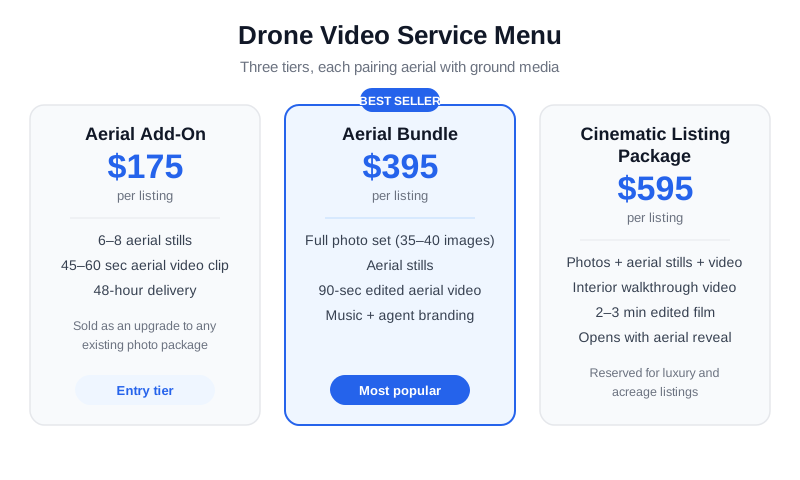
Three-tier drone service menu: the aerial add-on, the aerial bundle, and the full cinematic package.
- Aerial Add-On ($175): 6–8 aerial stills plus a 45–60 second aerial video clip, delivered 48 hours after the shoot. Sold as an upgrade to any existing photo package.
- Aerial Bundle ($395): full photo set (35–40 images), aerial stills, and a 90-second edited aerial video with music and the agent's branding. This became his best seller.
- Cinematic Listing Package ($595): photos, aerial stills, aerial video, interior walkthrough video, and a 2–3 minute edited film that opens with an aerial reveal. Reserved for luxury and acreage listings.
The pricing logic is worth stealing: the add-on exists to make the bundle feel like a deal, and the bundle exists to capture the walkthrough buyers already want. Average order value rose 42% in the first six months, from $187 to $266 per client — before accounting for the new listings the service won. If you're structuring your own menu, the pricing guide for real estate video services covers the per-video math in detail.
How He Marketed Drone Video to Agents
Mark didn't run ads. He used three tactics that cost almost nothing:
- The demo listing: he offered one aerial video free to each of his top 10 agent clients, no strings attached. Nine of the ten re-booked with the paid Aerial Bundle within 60 days.
- The compliance pitch: he carried his FAA Part 107 certificate and insurance certificate to brokerage meetings. Agents who had been told "our last drone guy wasn't licensed" became his most loyal referrers. FAA Part 107 rules require commercial drone pilots to be certified — the FAA's own registration data shows remote pilot certificates growing every year, tracked in the agency's UAS resources, and that requirement is a competitive moat, not a paperwork nuisance.
- The one-slide comparison: a single image showing a ground-level photo of a home on a half-acre lot next to the aerial version of the same home. Agents forwarded it to sellers unprompted.
The listing-side payoff followed the agent-side sell. Sellers who saw aerial video during the listing presentation asked for it by name, which meant agents started requesting drone video before they even listed — exactly the dynamic that pushed his booking rate up.
The Shoot-to-Delivery Workflow
Mark's biggest worry was editing time. A 90-second aerial video is 20–40 minutes of raw footage, and his old manual workflow would have added 2–3 hours of editing per listing. He solved this in two moves:
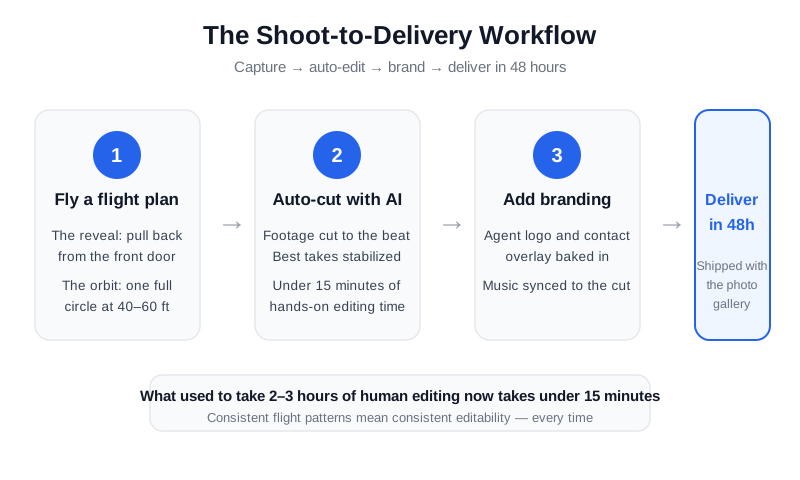
The delivery pipeline: fly a planned flight path, auto-edit with AI, add agent branding, deliver in 48 hours.
- Fly a flight plan, not a free-for-all: he standardized three flight patterns — the reveal (pull back from the front door), the orbit (one full circle at 40–60 feet), and the approach (forward flight over the roofline). Consistent patterns meant consistent editability.
- Automate the edit: raw clips went into VideoGuru, which cut the footage to the beat, stabilized the best takes, added the agent's logo and contact overlay, and exported a finished video. What used to take a human editor 2–3 hours took under 15 minutes of his time.
- Deliver with the photos: aerial video shipped in the same gallery as the stills, so agents never had to chase a second delivery.
This is where an AI media platform pays for itself. VideoGuru handles the video editing side — auto-cutting aerial footage, adding music and branding, and exporting in the right formats for MLS, Instagram, and YouTube. And because VideoGuru also turns listing photos into videos, Mark can repurpose a single shoot into an aerial film, a photo slideshow, and a social cut without reopening an editor. Beyond video, VideoGuru's photo editing tools give him one-click virtual staging and decluttering for stills too — the same AI that assembles his video walkthroughs also cleans up his listing photography.
A quick look at how aerial footage elevates a listing presentation.
The Results: 30% More Listings in 18 Months
Eighteen months after launch, Mark's numbers told a clear story:
- Listings per month: 22 → 29 (a 30% increase, matching the case study headline).
- Average order value: $187 → $266 (42% higher, driven by bundle adoption).
- Monthly revenue: roughly $4,100 → $7,700 — nearly doubled, even though his listing count grew by only a third.
- Editing time per aerial listing: 2–3 hours → under 15 minutes of hands-on time, thanks to automated editing.
- Referral rate: 3x — clients who received drone video referred other agents at triple the rate of photo-only clients.
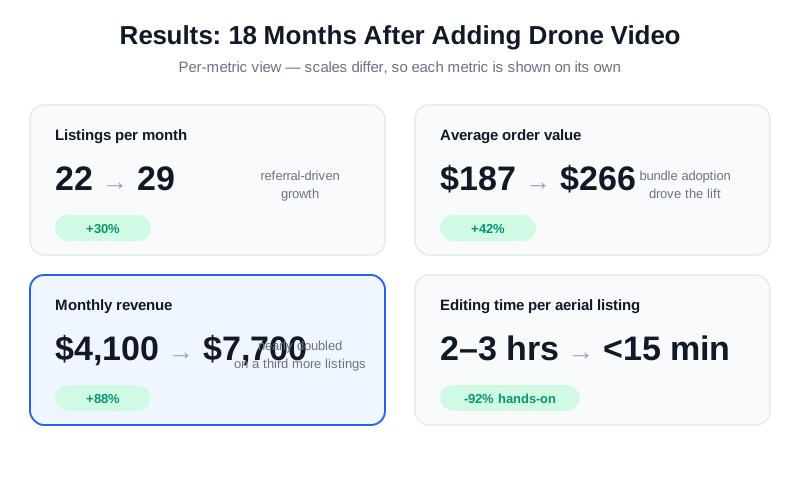
Revenue per month before and after adding drone video services.
Your numbers will differ — market, price point, and agent relationships all move the outcome. The durable lesson is structural: a service that (1) differentiates you in the bid, (2) raises average order value, and (3) costs under $2,500 to start, with editing absorbed by automation, is one of the highest-ROI additions a real estate photographer can make. For the full picture of how media companies scale this exact model, see white label editing vs automation and how agents choose and manage their photographers.
Frequently Asked Questions
Do I need a drone license to shoot real estate aerial video?
Yes. If you are paid for drone work in the United States, the FAA requires a Part 107 remote pilot certificate. The exam covers airspace rules, weather, and flight safety; most photographers pass with a few weeks of study. Certification is also a marketing asset — agents and brokerages increasingly ask for proof of licensing and insurance before booking aerial work.
How much should I charge for drone video services?
In most U.S. markets, a standalone aerial video package sells for $150–$250, while bundled photo + aerial video packages run $350–$600. The case study above used $175, $395, and $595 tiers. Bundle pricing consistently outperforms per-service pricing because it raises order value without making any single line item feel expensive.
Will drone video work for small or urban lots?
It depends. Aerial footage adds the most value when lot size, outdoor space, or neighborhood context is a selling point — suburban and rural listings, acreage, and homes near amenities. For a small city lot, a tight interior walkthrough may matter more. Offer aerial as an option rather than a default, and let the property dictate the recommendation.
Is drone video hard to edit?
Manually, it's the most time-consuming video you'll produce — 20–40 minutes of raw footage per 90-second deliverable. With AI-assisted editing, the pipeline collapses to under 15 minutes of hands-on time: automated cut selection, beat-synced transitions, music, and branding. That workflow is what makes drone video profitable at photographer-level prices.
How can I effectively promote my real estate listings online?
Start with media, not ads. A listing with a video walkthrough and aerial clip gets roughly 4x more inquiries than a photo-only listing, so the highest-return promotion is to shoot the media first, then push it to the portals, your social feed, and your email list. Layer paid promotion on top: a $100–$300 boosted post targeted at the listing's local audience typically reaches 5,000–20,000 viewers in a week. Track which channel drives showing requests and put the next listing's budget there.
How much does advertising for real estate listings cost?
A video-first listing campaign usually costs $50–$500 per listing beyond the media itself. Organic posting is free; boosted social posts start around $5–$10 a day; and a one-week local campaign across Facebook and Instagram typically lands between $100 and $300. Brokerages often fold this into a per-listing marketing fee so the seller sees advertising as part of the service rather than an add-on.
What This Means for Your Business
Mark's story is repeatable because it doesn't depend on exceptional talent or a big budget. It depends on three decisions: get certified, bundle aerial with ground media, and automate the edit. The drone is a modest investment, the differentiation is immediate, and the editing bottleneck — the reason most photographers avoid video — disappears with the right tools. If you are already delivering video marketing for your agent clients, adding aerial video is the fastest upgrade to that offering.
Ready to turn your drone footage into listing videos that sell? VideoGuru's AI video editing can cut your aerial clips into branded, music-synced listing videos in minutes — right alongside your photo editing workflow. Start for free at VideoGuru.