

Chengran (Felix) Guan
2026-07-07 · 15 min read
Real Estate Video Marketing Strategy:
A Step-by-Step Guide for Agents

A structured video marketing plan helps agents convert more listings into sales.
What Is a Real Estate Video Marketing Strategy — and Why You Need One
A real estate video marketing strategy is a documented plan for what video you make, where you publish it, how often, and how you measure it — built around one goal: win more listings and sell them faster. The right plan depends on who you are. Solo agents get the most from a walkthrough-plus-Reels loop they can sustain at 3–4 posts a week. Teams and brokerages need a repeatable pipeline so every listing ships with video, not just the flagship ones. Photographers and media companies should treat video as a productized add-on with a fixed turnaround. In every case, agents who follow a documented video strategy see up to 73% higher social engagement and roughly 2.5x more listing inquiries than agents posting at random, according to real estate marketing benchmarks. Using video in real estate marketing is not a separate channel from the rest of your plan — it is the asset every other channel (email, social, listing pages, ads) is built around. The five steps below give you the real estate video marketing strategies that still hold in 2025 and beyond, plus how they change for brokerages, developers, and investors.
Most agents start making videos without a plan: a walkthrough here, a testimonial there, an open house clip when they remember. The result is inconsistent content that fails to build a recognizable brand or drive measurable results. A documented strategy solves that by giving you a repeatable framework — one that turns video from a sporadic task into a consistent lead-generation engine.
Key Takeaways
- Strategy beats randomness: A documented video plan generates 2.5x more listing inquiries than unstructured posting.
- Six video types work: Walkthroughs, neighborhood tours, testimonial interviews, market updates, behind-the-scenes clips, and FAQs cover every stage of the buyer journey.
- Platform matters: Instagram Reels and YouTube Shorts drive discovery; longer content belongs on YouTube and your website.
- Consistency is the multiplier: Posting 3-4 times per week outperforms sporadic high-production content by 4x in overall reach.
- ROI is measurable: Track views → leads → showings → offers per listing to prove video's impact and refine your approach.
1. Choose Your Video Content Types
The most effective real estate video marketers don't create one type of video — they build a content mix that serves buyers and sellers at different stages. Here are the six proven formats:
Listing Walkthroughs (The Foundation)
Every listing gets a walkthrough. These are your highest-ROI videos because they directly support the sale. A well-shot 60-90 second tour showing the flow of a property generates more engagement than static photos. For tips on creating walkthroughs that actually get watched, see our guide on how to make real estate videos that get views.
Neighborhood Tours
Buyers don't just buy a house — they buy a location. Show the local coffee shop, park, school, and commute route. These videos position you as a local expert and get shared by community members, extending your organic reach.
Client Testimonial Interviews
Nothing builds trust like a happy client telling their story on camera. Record a 2-3 minute interview after closing. Ask about their fears, what you did to address them, and the outcome. These convert sellers better than any other format.
Market Update Videos
Weekly or monthly market snapshots establish authority. Cover median price trends, days on market, inventory levels, and your take on what it means for buyers and sellers. A 60-second market update posted every Monday can become your most consistent lead-generation tool.
How top real estate agents structure their weekly video content calendar.
A weekly content calendar ensures consistent posting without last-minute scrambling.
Creative Real Estate Marketing: Branding and Network Strategy With Video
Creative real estate marketing is not about gimmicks. It is about giving people a reason to remember you in a feed where every agent posts the same kitchen pan. The formats that get shared most are the ones that show a point of view: a 30-second "what $600K buys in three neighborhoods" comparison, a before-and-after renovation or virtual staging reveal, a "day in the life" of an open house, or a myth-busting clip on a local rule buyers get wrong. One creative concept, repeated weekly as a series, outperforms ten unrelated one-offs because viewers know what to expect and come back for it.
A real estate branding strategy is what makes those videos add up to something. Decide three things and lock them for 12 months: who you serve (first-time buyers in two zip codes, relocating families, $2M+ sellers), what you look and sound like (the same intro, lower-third, font, and music on every clip), and the one promise your videos keep (the most honest market read in town, the fastest listing launch, the best-staged homes). Agents who hold a consistent visual identity are recognized in a feed within 4–6 weeks; agents who change styles every post never are. Our guide on how to build a real estate brand with video content covers the brand kit and series structure in detail.
Real estate network marketing — growing your referral base through other people's audiences — is where video pays off twice. The same walkthrough you post for buyers becomes a clip you send to a lender, a contractor, or a past client with a two-line note. Practical plays: film a 60-second Q&A with one local business owner a month and let them share it; send a monthly market update clip to your sphere by text instead of a newsletter; and tag the photographer, stager, and lender in every listing video so their followers see it too. Agents who run a referral-partner series report that 30–40% of their video-sourced leads come from partners re-sharing, not from their own followers.
2. Choose Your Distribution Platforms
You don't need to be everywhere. Pick two or three platforms and do them well. Here's how the major platforms perform for real estate video:
| Platform | Best For | Video Length | Post Frequency |
|---|---|---|---|
| Instagram Reels | Discovery, brand awareness | 15-60 seconds | Daily |
| YouTube | Full walkthroughs, SEO | 3-10 minutes | 2-3x per week |
| Facebook / Marketplace | Local audience, older buyers | 1-3 minutes | 3-4x per week |
| TikTok | First-time buyers, trends | 15-60 seconds | 1-2x daily |
| Referral network, credibility | 1-3 minutes | 2-3x per week |
Our recommendation for most agents: Instagram Reels + YouTube + your website. Reels drive discovery. YouTube captures search traffic with long-form content. Your website becomes the portfolio hub where serious buyers go deeper. If you're short on time, start with Reels and repurpose the same footage into YouTube Shorts — the same clip can serve both platforms with minimal editing adjustments.
What Are the Best Platforms for Real Estate Video Marketing?
For most agents the answer is three: Instagram Reels for discovery, YouTube for search and long-form walkthroughs, and your own website as the hub serious buyers return to. Which one leads depends on your market. Agents selling to first-time buyers under 35 should add TikTok — it is the only platform where an unknown agent can reach 10,000+ local viewers in a week with zero ad spend. Agents working referral-heavy luxury or commercial markets get more from LinkedIn and email than from TikTok. Facebook still matters for buyers over 50 and for Marketplace listing traffic.
The mistake is trying to be everywhere. Two platforms done consistently beat five done sporadically. Pick the two that match your buyer's age and price point, post on a fixed schedule, and repurpose the same footage across both. See our platform-by-platform breakdown in the real estate video platform guide for length, format, and cadence per channel.
3. Set Your Posting Cadence
Consistency matters more than perfection. Data from National Association of Realtors research shows that real estate professionals who post video at least 3-4 times per week see 4x more organic reach than agents who post sporadically with higher production value. Here's a realistic weekly schedule:
- Monday: 60-second market update video (your take on last week's data)
- Wednesday: New listing walkthrough or "coming soon" teaser
- Friday: Client testimonial or sold property showcase
- Saturday/Sunday: Neighborhood tour or lifestyle content (local restaurant, park, event)
Four posts per week sounds like a lot — and it is, if you're editing each one by hand. That's where an automated workflow makes the difference. Using a tool like VideoGuru's AI video editor, you can turn 15 minutes of raw footage into a polished walkthrough in under an hour, freeing up time to create the other three posts. For more detail on turnaround, read our analysis of real estate video costs and the AI alternative.
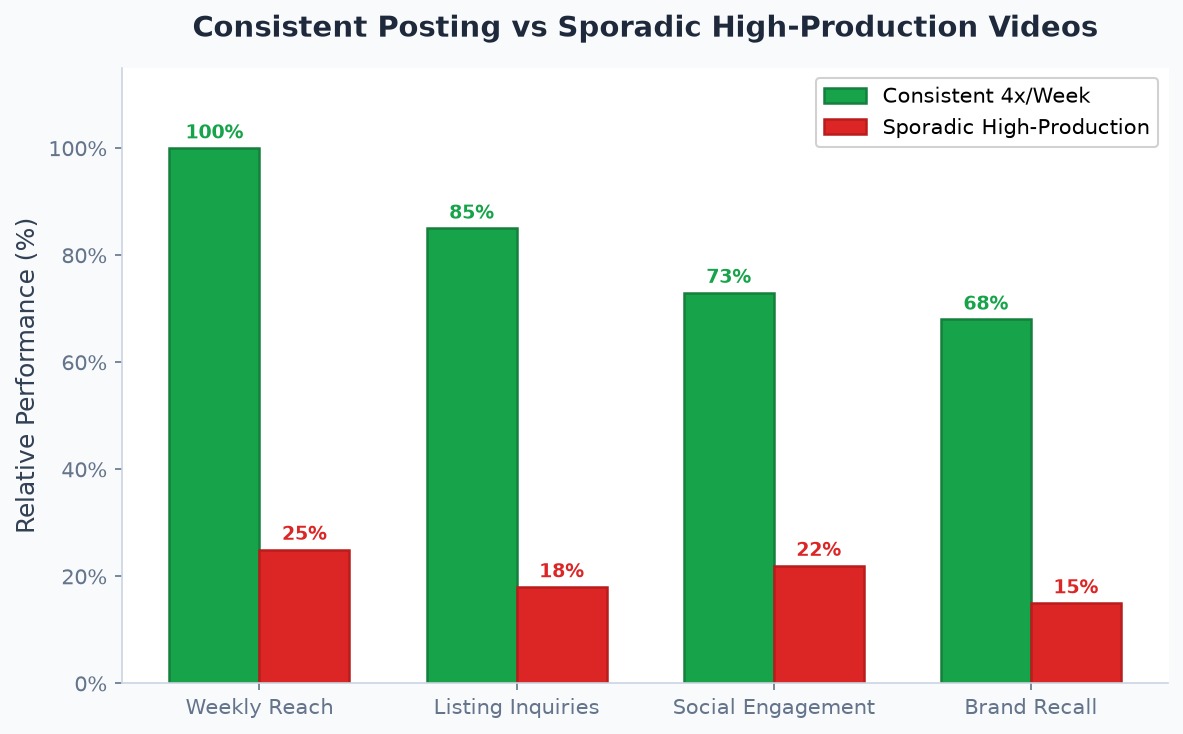
Consistent 4x/week posting generates 4x the reach of sporadic high-production videos.
One Video, Multiple Formats
The most time-efficient agents shoot once and distribute everywhere. A single listing walkthrough can become: a 60-second Reel (horizontal crop for Instagram), a 15-second TikTok teaser, a 3-minute YouTube video with intro/outro, an embedded video on your listing page, and a sound-bite clip for LinkedIn. Batch content creation like this makes the 4x/week cadence achievable without spending every evening in front of editing software. Our guide on how to create real estate videos that actually get views covers repurposing strategies in more detail.
4. Measure What Matters
Video marketing ROI isn't about vanity metrics. Here's what to track and why:
- Views and watch time — Tells you whether the content is engaging. On YouTube, videos with over 60% average watch duration get boosted in search results. If your walkthroughs lose viewers in the first 15 seconds, the opening needs work.
- Leads per video — Track how many inquiries each video generates. A video that consistently produces 3-5 inquiries per listing is outperforming most listing photos.
- Showings → offers — This is the core business metric. Listings with video walkthroughs generate 403% more inquiries than those without, according to real estate listing data aggregated across major MLS platforms. Track the conversion rate from showing to offer for listings with video vs. listings with photos only.
- Listing wins — When you pitch a seller, how often does your video marketing playbook help you win the listing? This is the most meaningful ROI metric because it ties directly to revenue.
Set up a simple spreadsheet with columns for listing address, video type, platform, views, inquiries, showings, and offers. Review it monthly. After three months, you'll know exactly which video types and platforms drive the most business for your specific market.
How Does a Real Estate Digital Marketing Strategy Change for Brokerages, Developers, and Investors?
A real estate digital marketing strategy for a single agent and one for a brokerage share the same building blocks — video, social, email, a website that converts — but the goals are different. An agent markets listings. A brokerage markets two things at once: its listings to consumers, and its brand to agents it wants to recruit. The best digital marketing strategy for real estate brokerages treats video as infrastructure, not a per-listing decision: every listing gets a branded walkthrough as a standard deliverable, every agent gets a monthly market-update template, and the brokerage runs its own recruiting series (agent spotlights, training clips, production stories) on LinkedIn and YouTube. Brokerages that standardize video across the roster typically see 20–30% of their inbound recruiting conversations mention the content directly.
A real estate brokerage go-to-market strategy — opening a new office, market, or team — needs a 90-day plan, not a launch post. Weeks 1–4: publish a neighborhood tour series for the new market (8–12 clips) before you have listings, so search and social already show you as local. Weeks 5–8: launch the first listings with full video and paid boosts to the zip codes you want, at $10–$30 per day per listing. Weeks 9–12: add the recruiting series and a monthly market report video, and measure by listing appointments and agent inquiries rather than views. A complete real estate brokerage marketing guide would also cover MLS syndication, reviews, and email, but video is the layer that makes all of those convert better. See how a real estate team scaled video across 200 homes without adding editing staff.
Marketing strategy for real estate development runs on a longer clock. Developers sell before the building exists, so the video plan starts with renders and site progress: a monthly construction-update clip, a rendered walkthrough for pre-sales, and, closer to completion, virtually staged model units so buyers see finished rooms instead of drywall. Pre-sale campaigns that pair render walkthroughs with monthly progress video report 15–25% shorter absorption periods than static brochure campaigns. Real estate investors need a different angle again: a real estate investor video marketing strategy is about deal flow and capital, so the content is before-and-after rehab videos, a deal-breakdown series (purchase price, rehab cost, ARV), and short market-trend clips that attract private lenders and off-market sellers. In all three cases, an AI editor such as VideoGuru turns phone footage, renders, or listing photos into branded, platform-ready video at volume — the fit for teams that need 20+ videos a month with a consistent look.
Should You Hire a Video Marketing Agency, Use a Tool, or Do It Yourself?
There are three ways to get real estate video made, and the right one depends on your volume and budget. Video marketing agencies charge $500–$2,500 per listing video and $1,500–$5,000 per month for ongoing social content; they make sense for top producers and luxury listings above $2M where one video can justify the cost. Freelance editors (Fiverr, Upwork, local videographers) run $75–$300 per edit with 2–5 day turnaround — a good fit for agents closing 1–3 listings a month who can film their own footage. AI video tools take your raw clips or listing photos and produce a finished, branded walkthrough in minutes for a flat monthly fee — the fit for agents and teams who want video on every listing without adding editing time.
For agents who want a walkthrough from their own phone footage or MLS photos in about 10 minutes, VideoGuru is built for that job: it trims, color-corrects, adds branded intros and title cards, and exports vertical and horizontal cuts in one pass. Photographers use the same workflow to add video as a productized service without hiring an editor. If you are comparing options, our roundup of the best AI video editors for real estate covers pricing and turnaround for each approach. If you are weighing a real estate marketing expert or consultant instead, expect $150–$400 per hour or $2,000–$6,000 for a strategy package. That spend is worth it for a brokerage launch or a $2M+ listing plan, but for most agents the strategy in this guide plus a tool covers it — spend the money on filming and distribution instead.
5. Build Your Video Production Workflow
The difference between a strategy that works and one that collects dust is the production pipeline. Without a repeatable workflow, even the best content plan falls apart after week two. Here's the five-step pipeline used by agents who sustain 4x/week posting:
- Shoot in batches. Spend one afternoon per week filming all content for the next 7-10 days. Shoot the walkthrough, the neighborhood clips, and your face-to-camera market update in a single session.
- Upload to your editing tool. Use an AI editor designed for real estate to handle trimming, color correction, and transitions automatically. VideoGuru AI video effects for property tours can add branded intros, logo overlays, and property title cards in seconds — tasks that take 30-40 minutes manually.
- Export platform-specific cuts. Export a 60-second landscape version for YouTube and a 9:16 vertical version for Instagram/TikTok. AI tools with auto-crop features do this in one click.
- Schedule. Use a social media scheduler (Meta Business Suite, Buffer, or Later) to queue posts for the week. Batch this once per week.
- Review and adapt. Every Sunday, check which videos performed best. Double down on what works and drop what doesn't.
The right tool for this workflow can cut your per-video editing time from 4 hours to under 1 hour. For a deeper look at available options, check our roundup of the best AI video editors for real estate in 2026.
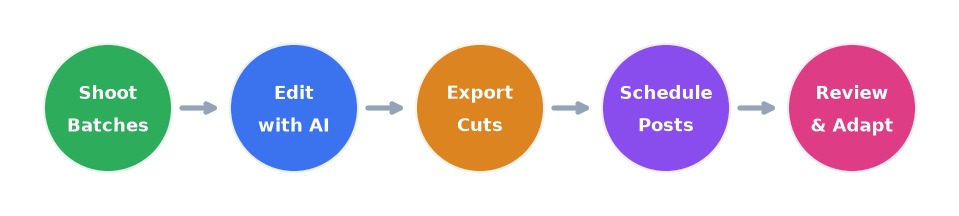
The five-step video production pipeline: shoot in batches, edit with AI, export for each platform, schedule, and review.
Frequently Asked Questions
What are the best content marketing strategies for real estate agents?
The strategies that consistently generate leads are the ones that answer a buyer's or seller's question before they ask it: weekly market updates (what happened to prices and days-on-market in your area), neighborhood tours, listing walkthroughs, and short FAQ videos on topics like offer strategy or closing costs. Video is the highest-leverage format because one shoot can become a Reel, a YouTube video, a listing-page embed, and an email clip. Agents who post educational video 3–4 times a week see roughly 4x the organic reach of agents who post only when they have a listing.
How can realtors use social media to improve their content marketing?
Treat social media as distribution, not the strategy itself. Film once a week in a batch, then cut that footage into platform-specific versions: a 15–60 second Reel or TikTok for discovery, a 3–10 minute YouTube video for search, and a 1–3 minute clip for Facebook and LinkedIn. Post on a fixed schedule so followers know when to expect you. The agents who grow fastest on social are not the best on camera — they are the most consistent. See our list of real estate video ideas for social media for formats that work.
Can content marketing help new real estate agents establish their brand?
Yes — and it is often the fastest path, because a new agent has no transaction history to lean on. A weekly market update video builds authority in 60 seconds a week; neighborhood tours position you as the local expert before you have sold a home there; and a consistent visual style (same intro, same lower-third, same music) makes you recognizable in a feed within a month. New agents should start with two formats and one platform, post three times a week, and add a second platform only once the first is on autopilot. Our guide on how a solo realtor turned one video a day into leads walks through a realistic first 90 days.
What do real estate video marketing services actually include?
It varies widely, which is why quotes are hard to compare. A full-service agency package typically includes filming, editing, a branded intro and outro, one vertical and one horizontal cut, and sometimes posting and ad management. Editing-only services expect you to supply footage and return a finished cut. AI video platforms sit in between: you supply phone footage or listing photos and get a finished, branded walkthrough plus platform-specific exports, with no per-video fee. Before you buy, ask for turnaround time, number of revisions, and whether you own the raw footage.
What real estate video marketing strategies work best in 2025 and beyond?
The strategies with the most durable results are vertical short-form video on Instagram Reels and TikTok for discovery (15–60 seconds, 3–4 posts a week), long-form YouTube walkthroughs and neighborhood tours for search, and a monthly market-update video sent by email and text to your sphere. Two shifts define 2025 onward: AI editing makes video on every listing affordable, and buyers increasingly use AI search engines that cite agents with clear, question-answering video content. For investors, the same playbook shifts to deal-breakdown and before-and-after rehab videos aimed at lenders and off-market sellers. Our real estate video trends roundup covers what is changing next.
Do you need a real estate marketing expert to use video for real estate marketing?
No. The agents winning with video are rarely the ones with the biggest marketing budget — they are the ones with a documented plan and a weekly routine. A phone with a gimbal, one batch-filming afternoon a week, and an AI editor gets you 3–4 finished videos a week for under $100 a month. Bring in an expert or agency when the stakes justify it: a brokerage launch, a development pre-sale campaign, or luxury listings above $2M where one film can cost $1,500–$5,000 and still pay for itself. Until then, use the real estate video analytics guide to measure what your own videos produce before you pay someone else to.
The Verdict
A real estate video marketing strategy doesn't have to be complicated, but it does have to be documented and consistent. The agents who dominate their markets with video are not necessarily the best on-camera talent or the most creative editors. They're the ones who follow a repeatable system: produce consistent content types, distribute across the right platforms, maintain a steady cadence, and measure what works.
Start with one video type — listing walkthroughs — and one platform — Instagram Reels. Post three times this week. Track inquiries. Next week, add YouTube. The week after, add market updates. Build the strategy one layer at a time, and within three months, you'll have a system that generates consistent leads without requiring you to become a full-time video producer.
If you want to see how AI can automate the production side of this workflow, try VideoGuru — it handles the editing so you can focus on creating content that gets results.